Pay@Browse - Self-service tablets

Company:Sainsbury's Argos (is a leading UK multi-channel retailer)
Role:Senior User Researcher
Project duration:4 months
Design team size:2 user researchers
Skills:User research, field studies, stakeholder management
Output & impact:Retained critical feature, improved store experience
Summary/Context
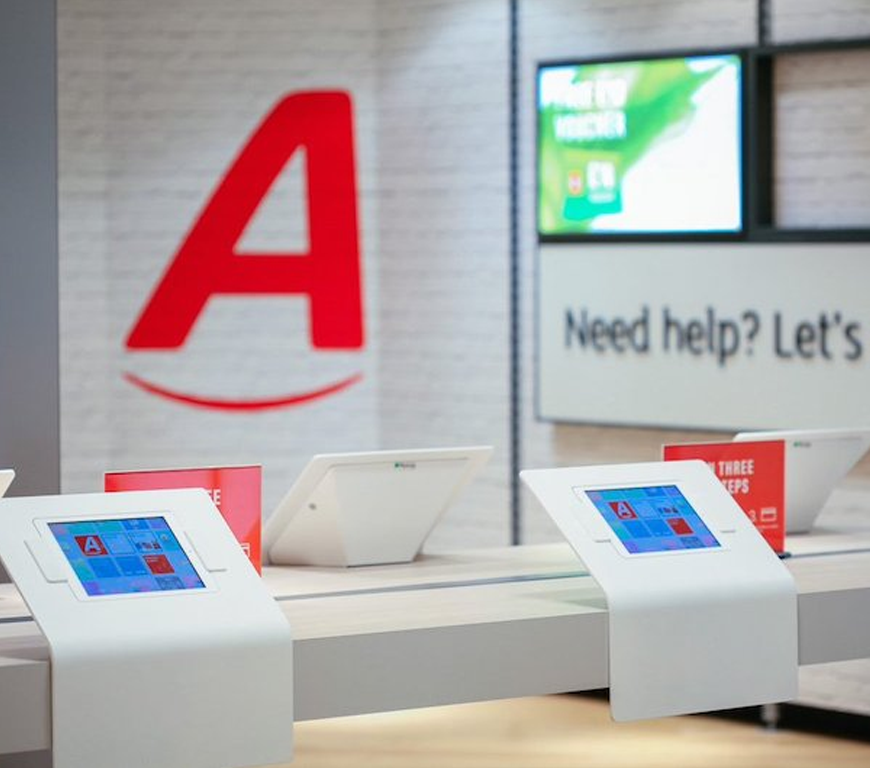
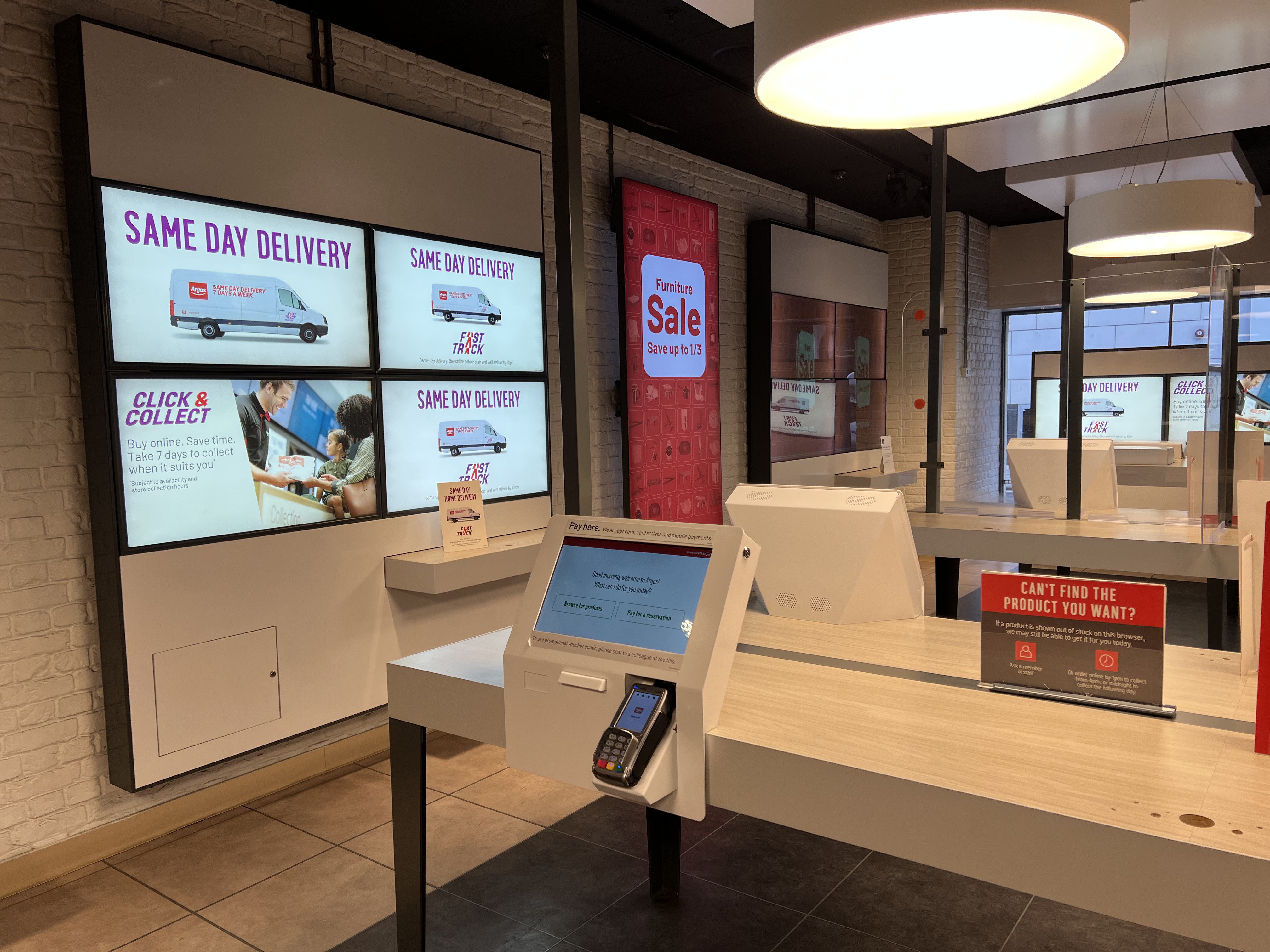
Following Sainsbury's acquisition of Argos, the company was evaluating its in-store digital infrastructure to optimise the customer experience and operational efficiency. Pay@Browse (P@B) tablets—digital interfaces allowing customers to browse and purchase items in-store—were under review for potential removal. The prevailing assumption was that these tablets had become redundant in a predominantly click-and-collect environment.
However, preliminary analytics revealed that 37% of Argos store visitors were actively using Pay@Browse tablets—significantly higher than anticipated. This unexpected usage pattern prompted a critical question: were these tablets still serving a valuable purpose, or were customers using them out of habit? The decision to retain or remove P@B tablets across Sainsbury's UK stores had major implications for customer experience, operational costs, inventory management, and the broader omnichannel strategy. This research project was commissioned to provide evidence-based recommendations.
Project phases

Research questions

Research goals
Challenges
Approach
Deliverables & impact
Research questions
- Why are customers using Pay@Browse tablets in a predominantly click-and-collect environment?
- What role do P@B tablets play in the customer journey and purchase decisions?
- How do P@B tablets influence cross-brand engagement within the Sainsbury's family (Argos, Habitat, Sainsbury's)?
- What is the demographic and behavioural profile of P@B users versus non-users?
- What operational and experience improvements could enhance the P@B service?
Research goals
- Understand the motivations and use cases driving 37% tablet usage rates
- Identify the customer segments most reliant on Pay@Browse functionality
- Assess the tablets' role in customer retention and loyalty
- Evaluate the impact of P@B on cross-brand purchasing behaviour within Sainsbury's ecosystem
- Uncover pain points in the current in-store experience and customer flow
- Provide evidence-based recommendations on whether to retain, remove, or enhance P@B tablets
Challenges
- Constraint: No access to external customers during research phase.
- Response: Recruited internal RES portfolio managers with equivalent roles. Triangulated findings through competitive analysis and validated assumptions during usability testing to mitigate insider bias.
- Additional Complexity: Bridging strategic and technical mental models required careful information architecture serving managers whilst maintaining connection to engineering data.
Challenges
Challenge 1: Limited initial scope The project was initially scoped to focus solely on the product sales department. However, early findings indicated broader systemic issues.Adaptation: Expanded research to include storage, operations, and signage teams, conducting additional stakeholder interviews to capture a holistic view.
Challenge 2: Multi-regional complexity Argos stores across England varied significantly in layout, customer demographics, and operational practices.Adaptation: Conducted field research across multiple regions to ensure findings were representative and not location-specific.
Challenge 3: Tight timeline with high-stakes decision The business needed rapid insights to inform store-wide decisions affecting hundreds of locations.Adaptation: Deployed mixed methods research (surveys + interviews + observational field studies) concurrently to maximise speed without compromising rigour.
Approach
In-Store Observational Field Research
Description: Ethnographic observation of customer behaviour in Argos stores across multiple regions in England, documenting how customers interacted with P@B tablets, signage, and store layouts.Sample size: 8 stores across different regionsKey findings:
- Long-term Argos customers (21+ years) exhibited deeply ingrained catalogue-browsing behaviour
- Store signage created confusion between P@B and click-and-collect queues
- For items requiring ID verification, the customer flow was inefficient (tablet → counter → tablet again)
Description: Ethnographic observation of customer behaviour in Argos stores across multiple regions in England, documenting how customers interacted with P@B tablets, signage, and store layouts.Sample size: 8 stores across different regionsKey findings:
- Long-term Argos customers (21+ years) exhibited deeply ingrained catalogue-browsing behaviour
- Store signage created confusion between P@B and click-and-collect queues
- For items requiring ID verification, the customer flow was inefficient (tablet → counter → tablet again)
Customer Surveys
Description: Structured questionnaires administered in-store to P@B users and non-users, focusing on motivations, frequency of use, and satisfaction.Sample size: 250+ customersKey findings:
- 68% of P@B users were loyal, long-term Argos customers
- P@B tablets were the preferred method for discovering product availability across nearby locations
- Out-of-stock scenarios prompted cross-brand exploration (Argos → Habitat → Sainsbury's)

Semi-Structured Customer Interviews
Description: In-depth interviews with P@B users exploring their shopping habits, decision-making processes, and relationship with the Argos brand.Sample size: 18 customersKey findings:
- Emotional attachment to the catalogue browsing experience
- Tablets provided reassurance and control in the purchasing process
- P@B enabled serendipitous discovery that online browsing didn't replicate
Stakeholder Interviews
Description: Interviews with store managers, sales teams, operations staff, and signage/marketing teams to understand operational constraints and cross-functional impacts.Sample size: 12 stakeholders across 5 departmentsKey findings:
- Store staff valued P@B for managing customer expectations around stock
- Operational teams identified inefficiencies in the ID verification flow
- Signage team unaware of confusion between P@B and click-and-collect queues
Analytics Review
Description: Analysis of existing usage data, dwell times, conversion rates, and drop-off points in the P@B journey.Key findings:
- 37% of store visitors engaged with P@B tablets
- Average session duration: 8 minutes
- 42% of P@B sessions resulted in cross-brand product exploration
Critical insights
Research Question 1: Why are customers using Pay@Browse tablets? Loyal, long-term Argos customers (particularly those with 21+ years of patronage) had a deeply ingrained relationship with the catalogue browsing experience. P@B tablets replicated this familiar behaviour, providing comfort, control, and a sense of discovery that online browsing didn't offer. For this segment, removing tablets would alienate a core loyal customer base.
Research Question 2: What role do P@B tablets play in the customer journey? P@B tablets served as a critical "stock discovery and navigation tool." When items were out of stock, the tablets displayed nearby availability across Sainsbury's family brands (Argos, Habitat, Sainsbury's), driving customers to explore alternative locations and products. This functionality was not replicated in any other channel.
Research Question 3: How do P@B tablets influence cross-brand engagement? The tablets acted as an unexpected driver of cross-selling within the Sainsbury's ecosystem. 42% of P@B sessions involved exploration across Argos, Habitat, and Sainsbury's product ranges, creating incremental revenue opportunities that would be lost if tablets were removed.
Research Question 4: Who are P@B users? P@B users were predominantly older, highly loyal Argos customers who valued tactile, in-store browsing. This demographic represented a significant retention risk if the service was discontinued.
Research Question 5: What improvements could enhance P@B? Store signage was unclear, creating confusion between P@B and click-and-collect areas. Additionally, the ID verification process for age-restricted items forced customers into a disjointed journey (tablet → counter → tablet), creating frustration and abandonment.
Deliverables
- Research scripts: Interview and survey protocols
- Customer questionnaires: Structured survey instruments
- Stakeholder mapping: Cross-functional impact analysis
- Insights board: Thematic analysis and affinity mapping (Miro)
- Detailed research report: Comprehensive findings document with visualisations
- Interview documentation: Transcripts and synthesis notes
- Feature backlog: Prioritised recommendations for product, signage, and operations teams
- Regional comparison report: Store-by-store analysis highlighting variations
Impact
Business Impact:
- Retention of high-value customer segment: Prevented alienation of loyal, long-term Argos customers
- Cross-brand revenue driver: Identified P@B as a £X million opportunity (estimated based on cross-selling data)
- Cost avoidance: Avoided costly removal and potential lost revenue from discontinued service
User Experience Impact:
- Improved store navigation: Signage redesign reduced customer confusion and improved flow efficiency
- Streamlined ID verification process: Reduced friction for age-restricted purchases
- Enhanced discoverability: Maintained a valued browsing experience for loyal customers
Organisational Impact:
- Evidence-based decision-making: Shifted the conversation from assumptions to data-driven strategy
- Cross-functional alignment: Research findings informed multiple departments beyond the original scope
- Research capability demonstration: Showcased the value of holistic, mixed-methods UX research in high-stakes business decisions